KAMIKAZ
Stack. Explode. Survive.
Clearing a row is not how you win. It is how you survive long enough to set off something much bigger.
Android 9 and up. English and French. No account.
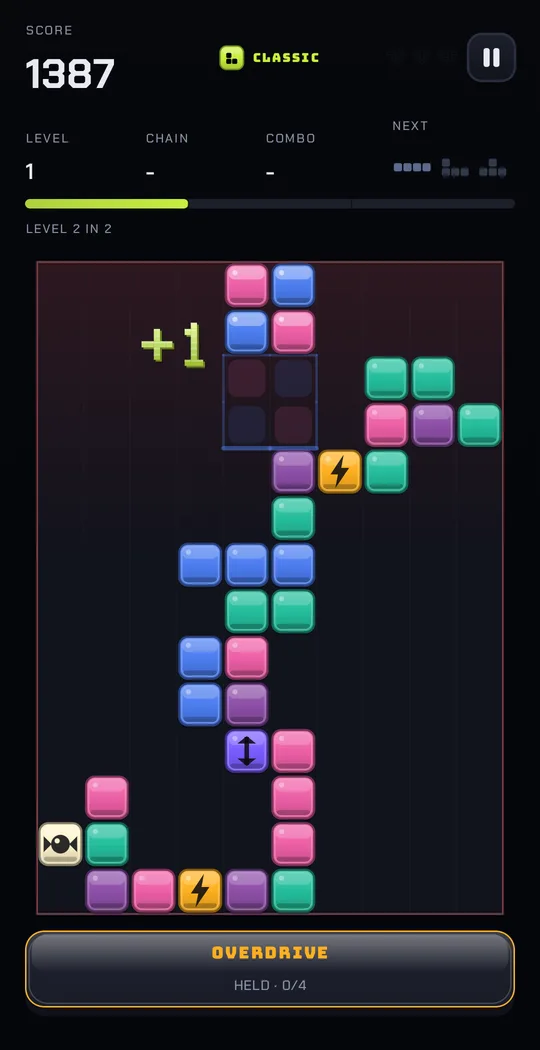
Three gestures, and you can play
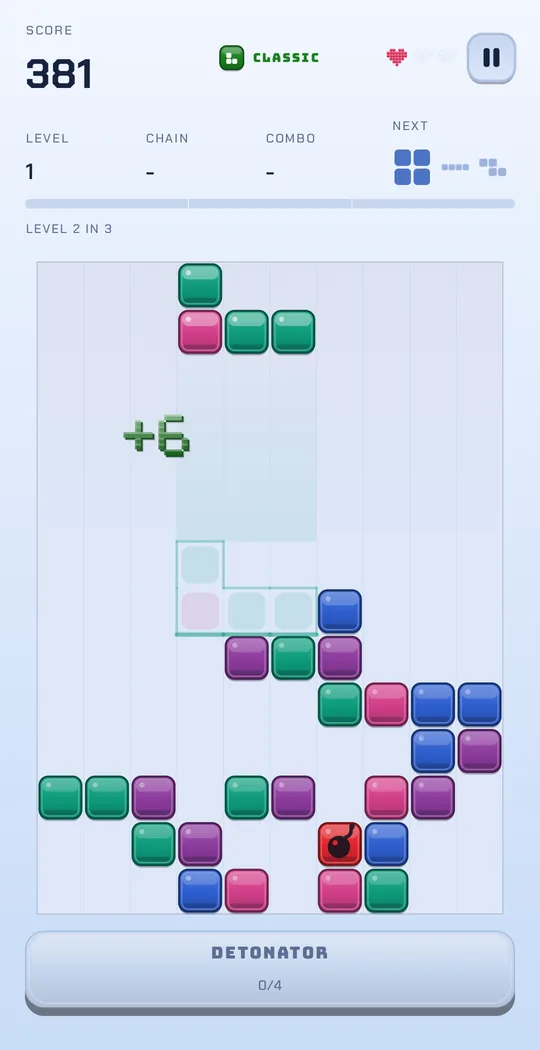
Drag
Move the piece from one edge to the other.
Tap
It turns a quarter turn.
Flick down
It drops. That is the whole control scheme.
You will have it in ten seconds. The rest is what you do with it.
Blocks that do something
About one block in three carries a rule. Land one next to another and the board comes apart in a single move instead of six.

Bomb
Goes off when the pressure around it builds, and takes its neighbours with it.

Charge
Widens any blast that reaches it. Two well-placed charges change the reach of the whole board.

Ice
Takes two hits. What it costs you is time, and time is the thing in short supply.

Beam
Answers to a cleared line rather than to an explosion. It is a different plan entirely.

Sweet
Broken, it pays a bonus. Always. It is the one block on the board worth going out of your way for.
A gauge, and you decide how to spend it
The detonator is not a button with one job. It arms one of four payloads, and you choose which.
- Set off every bomb on the board.
- Sweep the rows.
- Purge a colour.
- Double what your next pieces score.
Knowing which one to save it for is most of the game.
An upgrade every couple of levels. They stack, so no two runs are built the same.
Faster charging, wider blasts, more lives, softer landings. The run you finish is never quite the one you started.
Four modes, four questions
Not four difficulties. Each one asks something different.
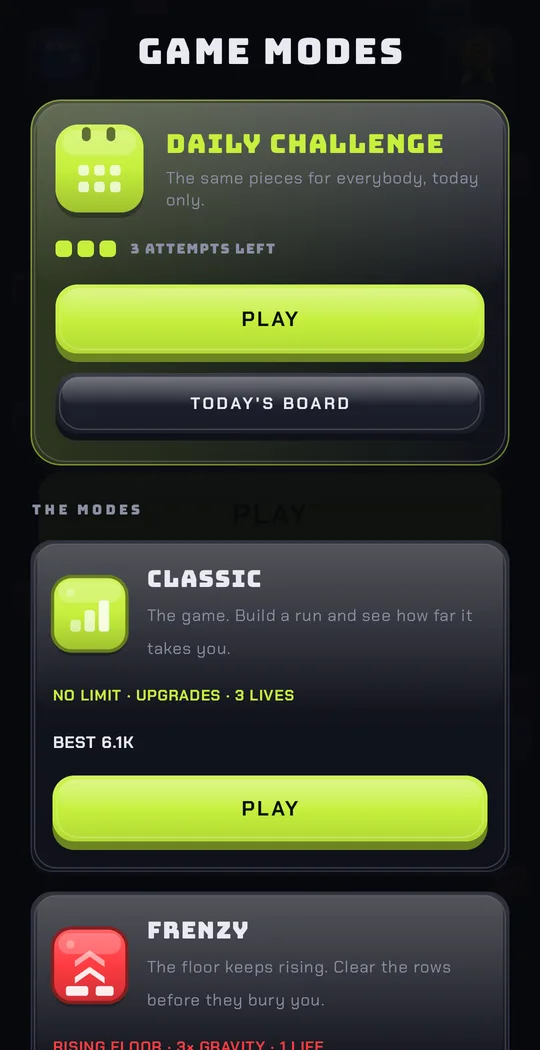
Classic
How far can you get? Endless, until the floor starts rising and gives it an ending.
Frenzy
Can you hold on? A new row is pushed in from underneath every few seconds, from the very first piece. You dig down against something pushing up.
Time attack
How much can you take in three minutes? The board is not the threat. The clock is.
Ghost
Are you better than you were? Your own best run plays beside you, block for block, and you race it.
A daily challenge
The same pieces for everybody, every day, three attempts. The day itself deals the deck.
Which means the only thing separating two players is how they played it. Nowhere else in the game is the comparison this exact.
Play your friends, face to face
Your card is a QR code. Show it, a friend scans it, and their leaderboard fills up with the people they have actually met.
Hand them one of your runs and it becomes a duel. Their turn to do better.
Measure yourself against the world
A world leaderboard for each of the four modes, and a separate one for the daily challenge.
Scores are checked before they go up. The place you take is a place you earned.
Three attempts, and the same pieces for everybody.
What the game does not do
No account
Nothing to create, nothing to remember. Install and play.
No ads, no analytics
No ad network, no tracker. There is nothing to opt out of because there is nothing there.
Offline
The whole game works without a network. Leaderboards are an option, off until you switch them on.
What leaves when you switch leaderboards on, and what never does, is set out plainly in the privacy policy.
Also in the box
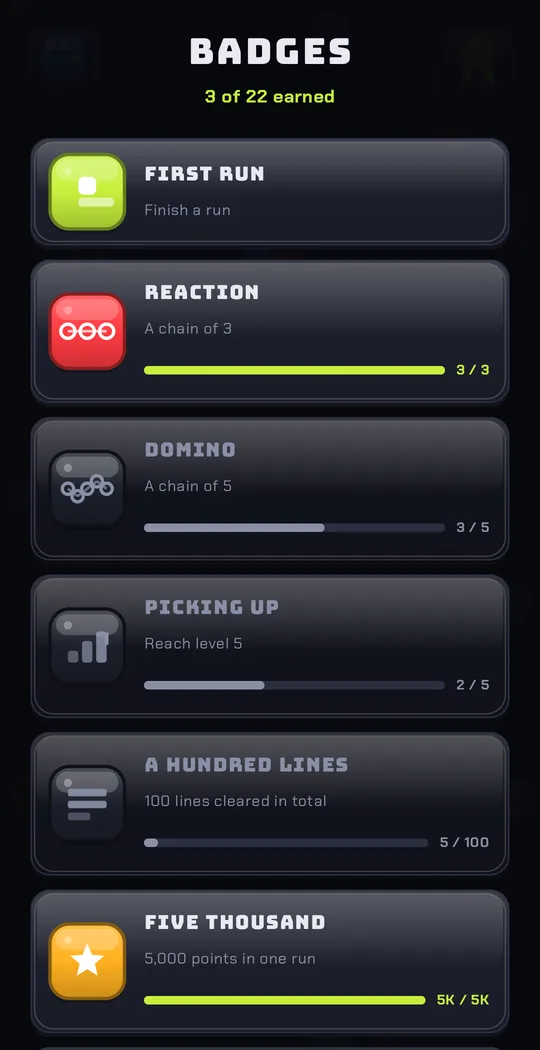
- Twenty-two badges, from your first cleared row to the ones that take weeks.
- A daily reward, with a streak to keep alive.
- A day look and a night look.
- The whole game in English and French.